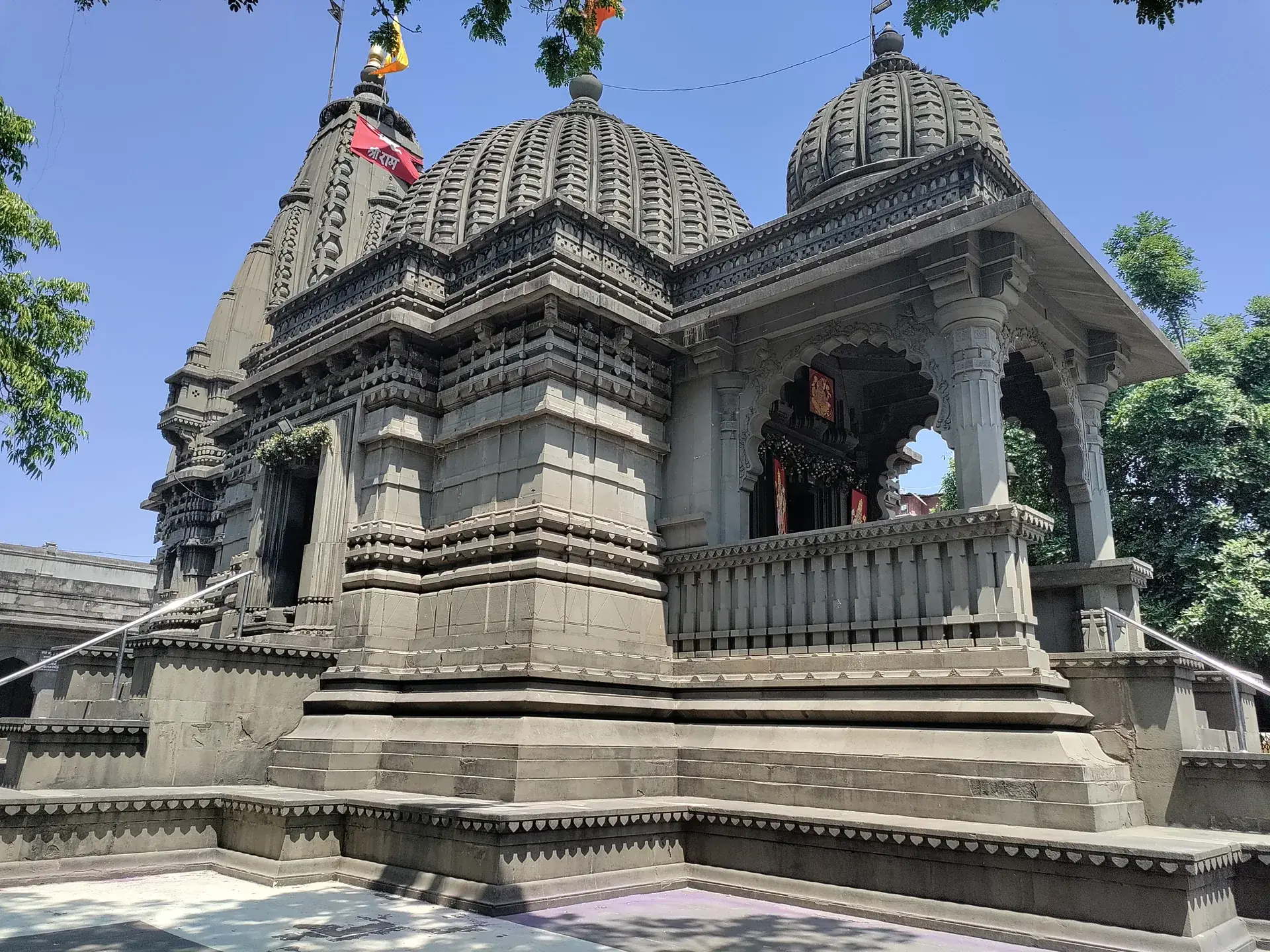
How darshan works at Trimbakeshwar Jyotirlinga, what the donation darshan costs, how Kaal Sarp puja is arranged, and a simple plan from Mumbai.
By Teerthayan • October 2026
Trimbakeshwar is one of the twelve Jyotirlingas of Lord Shiva, about 28 km from Nashik at the foot of the Brahmagiri hill, where the Godavari is believed to begin. This Trimbakeshwar temple guide explains how darshan works, what the paid donation darshan costs, and how the Kaal Sarp puja is arranged with the town's priests, so you can plan a calm visit from Mumbai, Pune or Nashik.
Why Trimbakeshwar matters
Most Jyotirlingas have a single lingam. At Trimbakeshwar the lingam sits in a small hollow and is described as having three faces, standing for Brahma, Vishnu and Mahesh. For most of the day it is covered with a silver mask, and the full form is shown at set aarti times. The black stone temple was rebuilt in the eighteenth century under the Peshwas, and its carved spire is visible from the lanes of Trimbak town.
Two other sacred spots sit close by. Kushavarta Kund, a short walk from the temple, is the tank where pilgrims bathe before darshan, and the Brahmagiri hill behind the temple is honoured as the source of the Godavari. Trimbakeshwar also shares the Simhastha Kumbh Mela with Nashik; our guide on how to reach the Nashik Kumbh Mela 2027 covers travel for that period.
Darshan options and donation darshan
General darshan is free. On ordinary weekdays the queue moves steadily, but on Mondays, during Shravan, on Mahashivratri and on long weekends it can take several hours. The Shri Trimbakeshwar Devasthan Trust also runs a paid donation darshan with a separate, shorter line.
| Option | Cost | Points to note |
|---|---|---|
| General darshan | Free | Longest wait on Mondays, festivals and weekends |
| Donation darshan pass | Rs 200 per person (trust website) | Booked online, valid only for the date chosen, carry ID and the QR pass |
| Children below 10 and Divyangjan | Exempt from the donation charge | Divyangjan should carry a UDID card or valid certificate |
The donation pass is booked on the official Trimbakeshwar Devasthan Trust website. It is non-transferable and the trust allows cancellation only within a short window after payment, so check your date before paying. Rates and timings can change on festival days, so look at the trust site in the week of travel. The temple opens early in the morning and closes late in the evening; the earliest hour, after the morning aarti, is usually the quietest.
Kaal Sarp puja at Trimbakeshwar
Many families come to Trimbakeshwar for rituals as well as darshan. The best known are Kaal Sarp Shanti (also written Kalsarpa Shanti), Narayan Nagbali and Tripindi Shraddh. Devotees perform Kaal Sarp puja when an astrologer finds that all the planets in a horoscope sit between Rahu and Ketu. Narayan Nagbali and Tripindi Shraddh are rites for ancestors and for the peace of departed souls.
Who performs the puja
These rituals are performed by Trimbakeshwar's hereditary purohits, often called tamrapatradhari priests because their families hold copper-plate rights to conduct rites here. The puja is not done inside the sanctum. It usually takes place at the priest's home or in a hall in Trimbak town, and the family then goes for temple darshan.
Practical points
- Fix the date and the priest in advance, especially for Shravan, Amavasya and Mahashivratri, when demand is high.
- A Kaal Sarp puja typically takes a few hours. Narayan Nagbali may need more than one day, so ask the priest how long to stay.
- Ask the priest what to wear. Many ask men to wear a dhoti and women traditional clothes, and some ask for new or white clothes.
- Agree on the dakshina and what it covers (samagri, havan, food) before the day.
- Be wary of anyone who stops you on the road offering a puja. The temple trust and the priests' organisations publish contact details for genuine bookings.
Puja charges are not part of a tour price. In our Trimbakeshwar package these rituals are listed as available on request at extra cost, along with any special abhishekam at the temple.
How to reach Trimbakeshwar
| From | Distance and time (approx.) | Notes |
|---|---|---|
| Nashik | 28 km, about 45 minutes | Taxis and state buses run through the day |
| Mumbai | To Nashik in about 3 to 3.5 hours | Via Kasara Ghat or the Samruddhi Expressway |
| Shirdi | Nashik to Shirdi about 90 km, 2 hours | Easy to combine on the same trip |
The nearest major railhead is Nashik Road. Nashik has its own airport, and Mumbai's international airport is the larger gateway. Most pilgrims stay in Nashik and drive up early, though Trimbak town also has simple lodges near the temple.
Best time to visit
Every Trimbakeshwar temple guide comes back to timing. October to February is the most comfortable season, with cool mornings and clear skies. The monsoon (July to September) turns Brahmagiri green and is the season of Shravan, the busiest month for Shiva devotees, but the roads are wet and the queues long. Summer afternoons are hot, so plan darshan for early morning.
A simple four-day plan
Our Trimbakeshwar Yatra from Mumbai is priced from ₹ 10,500 for 4 Days / 3 Nights, starting from Mumbai. It includes three nights in Nashik and Shirdi, daily breakfast and dinner, a private AC vehicle for all road transfers, and the sightseeing listed in the programme.
- Day 1: Mumbai to Nashik. Panchavati, Sita Gupha, Ramkund and the Kalaram Temple.
- Day 2: Early drive to Trimbakeshwar, Kushavarta Kund and Jyotirlinga darshan, with an optional Brahmagiri parikrama.
- Day 3: Nashik to Shirdi for Sai Baba Samadhi darshan, Dwarkamai and Chawadi.
- Day 4: Kakad Aarti in Shirdi and the drive back to Mumbai.
If you want to see more of Maharashtra's Shiva shrines, the Maharashtra Jyotirlinga circuit adds Bhimashankar and Grishneshwar. Our 12 Jyotirlinga list shows where Trimbakeshwar fits among all twelve.
Trimbakeshwar temple guide: tips for a smooth visit
- Carry a valid photo ID, and the QR pass if you booked donation darshan.
- Mobile phones, bags and leather items are best left in the car or at the lockers near the temple.
- Dress modestly. Shorts and sleeveless tops are not suitable.
- Elderly pilgrims should avoid Mondays and festival days, when standing time is longest.
- The Brahmagiri parikrama is a forest walk of about 8 km and takes 4 to 5 hours. Start early and carry water.
Plan this way and your Trimbakeshwar visit, with or without a Kaal Sarp puja, can be unhurried and meaningful.
FAQs
Is darshan free at Trimbakeshwar?+
Yes, general darshan is free. The temple trust also offers a donation darshan pass of Rs 200 per person with a shorter queue, booked on the trust website. Children below 10 and Divyangjan are exempt from the charge.
Where is Kaal Sarp puja done at Trimbakeshwar?+
It is performed by Trimbakeshwar's hereditary purohits, usually at the priest's home or a hall in Trimbak town, not inside the sanctum. Families then go for temple darshan.
How long does Kaal Sarp puja take?+
A Kaal Sarp puja typically takes a few hours. Narayan Nagbali can need more than one day, so confirm the duration with your priest before fixing travel.
How far is Trimbakeshwar from Nashik?+
About 28 km, roughly 45 minutes by road. Taxis and state buses run from Nashik through the day.
What is the best time to visit Trimbakeshwar?+
October to February is the most comfortable. Shravan in the monsoon is the busiest month, and Mondays and Mahashivratri bring the longest queues.
Share this article