The three and a half Shakti Peeths of Maharashtra are Kolhapur, Tuljapur, Mahur and Saptashrungi. Here is how to visit all four in one road trip.
By Teerthayan • October 2026
The Sade Teen Shakti Peeth of Maharashtra are the "three and a half" seats of the Goddess that devotees in the state hold above all others: Mahalakshmi (Ambabai) at Kolhapur, Tulja Bhavani at Tuljapur and Renuka Mata at Mahur are the three full peeths, and Saptashrungi Devi at Vani near Nashik is the half. Visiting all four takes about a week by road because they sit at the far corners of the state, from the Sahyadri hills near Nashik to the Marathwada border with Telangana and down to Kolhapur in the south-west.
What "Sade Teen" means
"Sade teen" is Marathi for three and a half. In Maharashtra's Devi tradition the four shrines together are said to complete one whole: the three full peeths are seen as forms of Mahalakshmi, Mahakali and Mahasaraswati, and Saptashrungi is honoured as the half that holds the sacred syllable. Families often make the circuit after a vow, a wedding or the birth of a child, and many households have one of the four as their kuldevi. The sade teen shakti peeth list is a regional tradition and is different from the pan-Indian list of 51 or 18 peeths; you can read about that wider list in our Shakti Peeth list guide.
The four temples at a glance
| Temple | Town and district | Status in the circuit | Nearest railhead |
|---|---|---|---|
| Saptashrungi Devi | Saptashrung Gad, Vani, Nashik district | Half peeth | Nashik Road |
| Renuka Mata | Mahur (Mahurgad), Nanded district | Full peeth | Kinwat (small) or Nanded |
| Tulja Bhavani | Tuljapur, Dharashiv district | Full peeth | Solapur or Dharashiv |
| Mahalakshmi (Ambabai) | Kolhapur city | Full peeth | Kolhapur |
Saptashrungi Devi, Vani
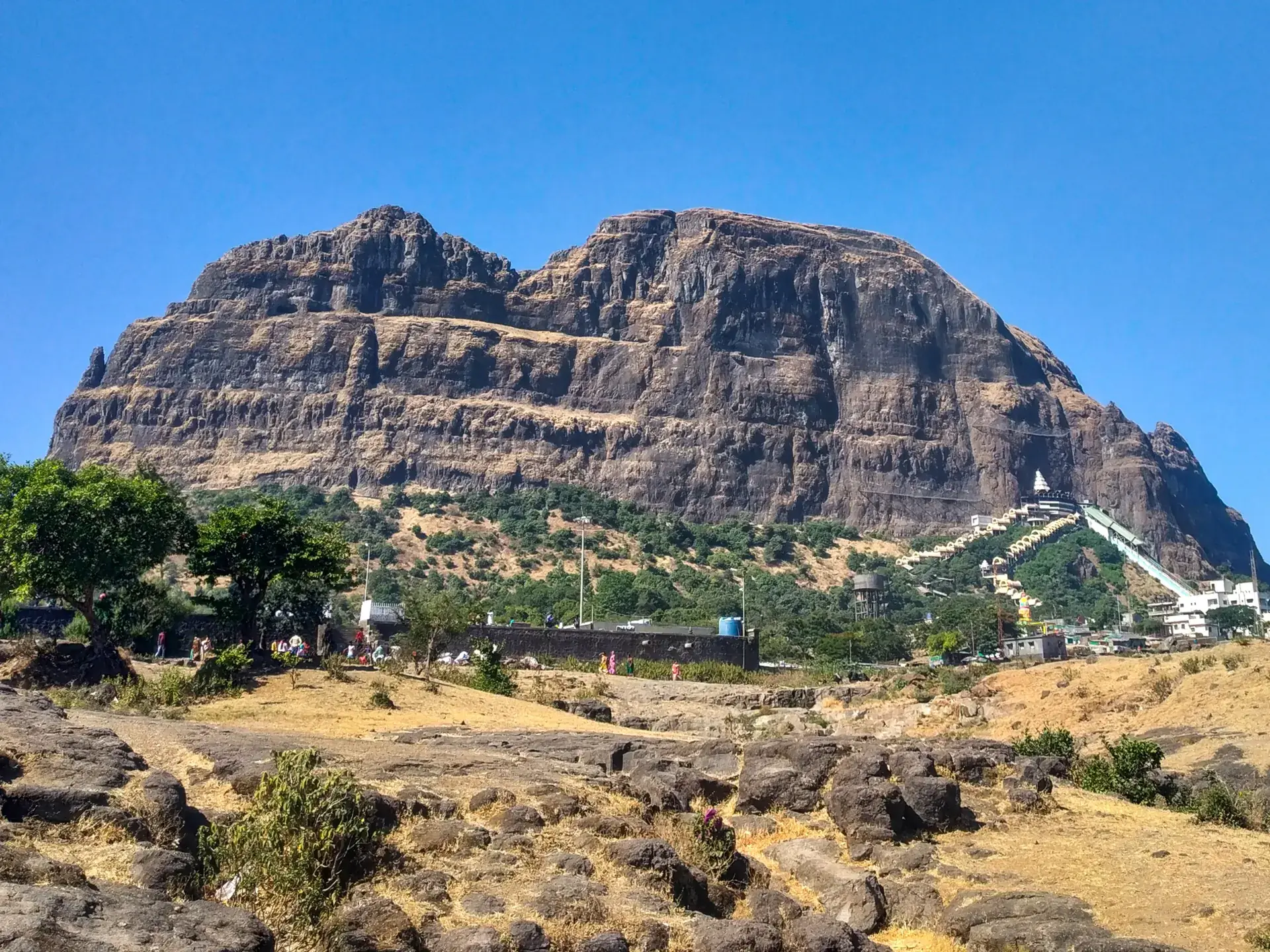
The goddess here is an eighteen-armed form of the Devi, carved into the rock face of a hill ringed by seven peaks, which is where the name Saptashrungi comes from. The shrine is reached by about 500 steps cut into the hill, and since 2018 a funicular trolley has carried pilgrims most of the way up in a few minutes, leaving only a short flight of stairs at the top. The temple trust lists Kakad Aarti at 5:30 am and the evening aarti at 7 pm; check the Shri Saptashrungi Nivasini Devi Trust site before you go, as timings change on festival days. The hill is about 60 km from Nashik, so most pilgrims combine it with Panchavati, Ramkund and the Trimbakeshwar temple.
Renuka Mata, Mahur
Mahur is the most remote of the four, in the forested hills of Nanded district about 130 km from Nanded city. Renuka Mata is worshipped here as the mother of Lord Parashurama, and the same hill complex has the shrines of Anusaya Mata and Lord Dattatreya, so allow half a day. The temple stands on a hilltop, so expect some climbing; ask locally about the current access arrangements.
Tulja Bhavani, Tuljapur
Tulja Bhavani was the kuldevi of Chhatrapati Shivaji Maharaj, and the temple is a black-stone complex entered by steps going down from the town. Tuljapur is about 45 km from Solapur. Queues are longest on weekends, full-moon days and through Navratri, so an early-morning darshan on a weekday is the most comfortable. In 2023 boards announcing a dress code appeared here and the temple committee said no dress code had been ordered; modest, traditional clothing is still the sensible choice.
Mahalakshmi (Ambabai), Kolhapur
The Karveer Niwasini Ambabai temple is in the old city of Kolhapur and faces west. On a few days each year the setting sun shines through the main doorway onto the idol, an event called Kiranotsav, usually around 9-11 November and again around 31 January to 2 February, though clouds can hide it. The Paschim Maharashtra Devasthan Samiti, which manages the temple, does not allow shorts, short skirts, ripped jeans, sleeveless tops or see-through clothes; traditional clothing can be bought near the gates if needed. Most visitors also go to Jyotiba temple on Wadi Ratnagiri, about 20 km away.
How to plan the route
There is no rule about the order. The practical choice is to start from the end nearest your home and work in a loop. From Mumbai or Pune, a common loop goes north to Nashik and Saptashrungi first, then east across Marathwada to Mahur, south to Tuljapur and finally west to Kolhapur, finishing back in Pune or Mumbai. That route also passes Aundha Nagnath, one of the shrines named in the 12 Jyotirlinga list, and Pandharpur, home of Vitthal-Rukmini.
| Leg | Approx. road distance |
|---|---|
| Mumbai to Nashik | About 170 km |
| Nashik to Saptashrung Gad | About 60 km |
| Nanded to Mahur | About 130 km |
| Solapur to Tuljapur | About 45 km |
| Pune to Kolhapur | About 230 km |
The longest stretch is the drive between Mahur and Tuljapur, so break it with a night at Nanded or Latur rather than trying to do darshan at both temples on the same day.
Our Sade Teen Shakti Peeth package
The Maharashtra Sade Teen Shakti Peeth Circuit is 8 Days / 7 Nights from Mumbai / Pune, priced from ₹ 34,900 per person (minimum 1 traveller). It covers Saptashrungi, Mahur, Tuljapur and Kolhapur along with Panchavati, Aundha Nagnath, Pandharpur and Jyotiba. The package includes:
- Seven nights of accommodation in the selected hotel category
- Seven breakfasts and seven vegetarian dinners
- Private air-conditioned vehicle for the complete Maharashtra road circuit
- Pickup and drop at one agreed point in Mumbai or Pune
- Darshan route planning for Saptashrungi, Mahur Renuka Devi, Tulja Bhavani and Kolhapur Mahalaxmi
- Driver allowance, fuel, toll taxes, interstate or state taxes and standard parking charges
- Teerthayan trip coordinator and 24x7 emergency assistance
Kolhapur gets two nights so that the Ambabai darshan is not rushed before the long drive home.
Best time to go
October to February is the most comfortable season: the monsoon has ended, the hills around Saptashrung Gad and Mahur are green, and road days are not too hot. Navratri, in both Chaitra (March-April) and Ashwin (September-October), is the most important time at all four temples, but it is also when queues are longest and hotels near the temples fill early. April and May are very hot in Marathwada and Solapur. During the monsoon the Saptashrung Gad and Mahur hill roads can be slippery and misty.
Practical tips
- Start early. Morning darshan before 8 am avoids most of the crowd at Tuljapur and Kolhapur.
- Dress modestly at all four temples; Kolhapur enforces a written dress code.
- Keep phones and bags to a minimum; some temples have cloakrooms and do not allow them inside.
- Elderly travellers can use the Saptashrungi funicular; ask at Mahur about the current arrangements for reaching the hilltop.
- Carry a light shawl for early mornings in winter, and see our pilgrimage packing list.
Completing the Sade Teen Shakti Peeth in one trip is easier than it looks on a map, as long as you accept about six hours of driving on the longer days and keep one quiet evening for rest.
FAQs
What are the Sade Teen Shakti Peeth of Maharashtra?+
They are Mahalakshmi (Ambabai) at Kolhapur, Tulja Bhavani at Tuljapur and Renuka Mata at Mahur, counted as the three full peeths, and Saptashrungi Devi at Vani near Nashik, honoured as the half peeth.
Which is the half Shakti Peeth in Maharashtra?+
Saptashrungi Devi on Saptashrung Gad near Vani, about 60 km from Nashik, is honoured as the half (ardha) peeth of the circuit.
How many days are needed for the Sade Teen Shakti Peeth yatra?+
Allow about seven to eight days by road from Mumbai or Pune, because the four temples are far apart. Our package is 8 Days / 7 Nights.
Is there a ropeway at Saptashrungi temple?+
Yes. A funicular trolley, opened in 2018, carries pilgrims up most of the hill. The alternative is a climb of about 500 steps.
Is there a dress code at Kolhapur Mahalakshmi temple?+
Yes. The Paschim Maharashtra Devasthan Samiti does not allow shorts, short skirts, ripped jeans, sleeveless or see-through clothes. Traditional clothing is sold near the temple.
Share this article