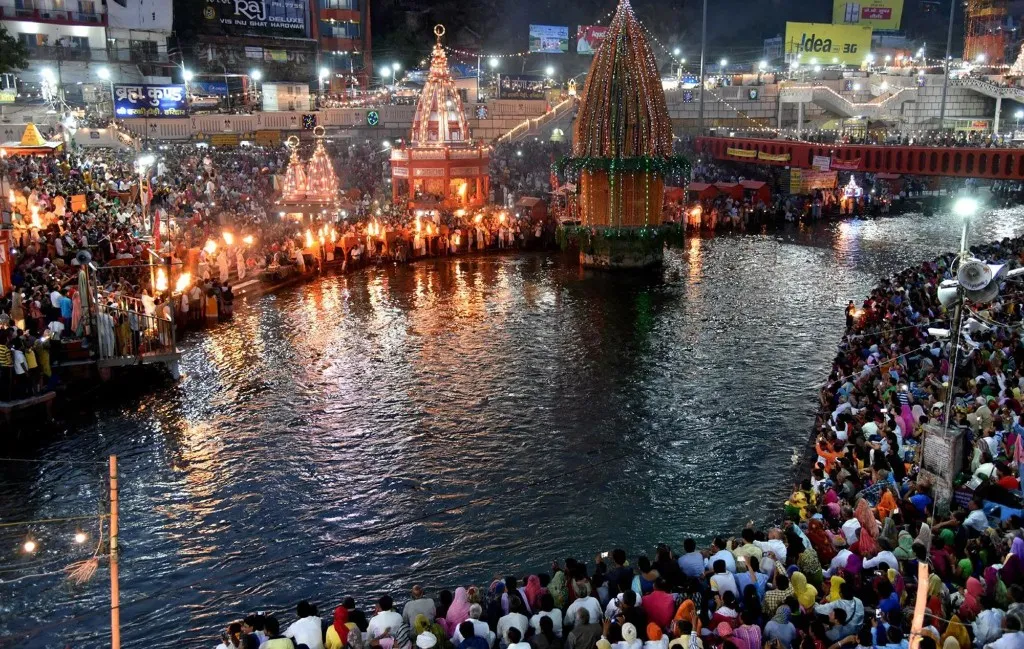
The evening Ganga Aarti at Har Ki Pauri is the moment most Haridwar pilgrims remember. Here are the timings, where to sit and how the Kumbh changes it.
The evening Ganga Aarti at Har Ki Pauri is the moment most pilgrims carry home from Haridwar: priests raising large flaming lamps over the river, bells and chanting, and thousands of small leaf boats with diyas drifting away on the current. It happens twice a day, at sunrise and at sunset, at Brahma Kund, the most sacred ghat in Haridwar and the main bathing place of the Kumbh Mela. This guide covers the timings by season, where to sit, how to take part and what changes during the Kumbh Mela of 2027.
Why Har Ki Pauri is sacred
Har Ki Pauri means the steps of Hari, Lord Vishnu, and a stone on the ghat is worshipped as his footprint. Tradition says King Vikramaditya built the first ghat here in memory of his brother Bhartrihari, who meditated on this bank of the Ganga. Brahma Kund, the heart of Har Ki Pauri, is where drops of amrit are believed to have fallen from the kalash after the churning of the ocean. That is why the Kumbh is held here, and why a dip at Brahma Kund on a snan day matters so much to pilgrims.
Ganga Aarti timings
The aarti follows the sun, so the time moves through the year. These are approximate times; confirm the day's time locally when you arrive.
| Season | Morning aarti | Evening aarti |
|---|---|---|
| Summer (about April to September) | Around 5 to 6 am | Around 6:30 to 7 pm |
| Winter (about November to February) | Around 6:30 to 7 am | Around 5 to 5:30 pm |
| March and October | Between the two | Around 6 to 6:30 pm |
The aarti itself takes about 20 to 30 minutes, with bhajans before it. The evening aarti is the one most people come for; the morning aarti is quieter and very beautiful in the mist.
Where to sit
- The steps at Brahma Kund: closest to the priests and the lamps. Arrive 45 to 60 minutes early in season, and earlier on festival days.
- The bridges over the canal: a good view of the whole ghat, though they fill fast.
- The island opposite the ghat, with the clock tower: a wide view of the lamps reflected in the river, and a little more space.
- Nearby ghats downstream: on very crowded days you will see less but stand in comfort.
Sit where you can see the river rather than right at the edge of the steps, where the current is strong. Volunteers and police keep the ghat moving after the aarti; follow their directions.
Taking part in the aarti
- Diya and flowers: leaf boats with a diya and marigolds are sold on the ghat. Light it and set it on the water during or after the aarti.
- Ganga jal: carry a small bottle or buy a sealed can to take Ganga jal home.
- Donations: the aarti is free. If you wish to give, use the official counters and take a receipt, and politely decline anyone who asks for money in the crowd.
- Dress and conduct: modest clothing, shoes left away from the steps, and no flash photography in people's faces during the prayers.
The Ganga Aarti during the Kumbh Mela 2027
The Kumbh Mela in Haridwar runs from 14 January to 20 April 2027, and the aarti continues every morning and evening through it. The crowd is much larger than usual, and three days are different:
- On the Amrit Snans of 6 March, 8 March and 14 April 2027, Har Ki Pauri is closed off for the Akhara processions and vehicles are stopped at the city limits. Watch the aarti from a nearby ghat or plan it for another evening.
- On other major snan days, arrive at least two hours early or watch from the bridges or downstream ghats.
- On ordinary mela days the evening aarti is crowded but manageable, and the lamps on the river with the camps lit up beyond them are worth the wait.
For the full list of snan days, how to get to Haridwar and a 3-day plan, read our Haridwar Kumbh Mela 2027 trip plan.
Practical tips
- Keep phones and wallets in a front pocket or a zipped bag.
- With children or elderly parents, fix a meeting point away from the steps before the aarti starts.
- Carry a shawl in winter: the wind off the river is cold after sunset.
- Leave a few minutes after the aarti ends; the rush to exit is the most crowded moment of the evening.
See the aarti on your yatra
Haridwar is the starting point for the Himalayan yatras, and most of our groups see the evening aarti on the first or last night. Our Char Dham Yatra from Haridwar and Do Dham Yatra from Haridwar start here. Coming for the Kumbh? See Kumbh camps and hotels in Haridwar and book a stay within walking distance of the ghat.
FAQs
What is the Ganga Aarti timing at Har Ki Pauri?+
The aarti follows sunrise and sunset. In summer the evening aarti is roughly between 6:30 and 7 pm and the morning aarti between 5 and 6 am. In winter the evening aarti moves to about 5 to 5:30 pm and the morning aarti to about 6:30 to 7 am. Check the day's time locally.
Is there an entry fee for the Ganga Aarti in Haridwar?+
No. The aarti at Har Ki Pauri is free and open to everyone. Donation counters are run on the ghat; give only at official counters and take a receipt.
Where is the best place to watch the aarti?+
The steps at Brahma Kund put you closest to the priests. The bridges and the island opposite the ghat, with the clock tower, give a fuller view of the lamps over the river. Arrive 45 to 60 minutes early for a place.
What is Brahma Kund?+
Brahma Kund is the most sacred spot at Har Ki Pauri, where drops of amrit are believed to have fallen from the kalash after the churning of the ocean. It is the main bathing ghat of the Haridwar Kumbh.
Is the Ganga Aarti held during the Kumbh Mela?+
Yes, every morning and evening. On Amrit Snan days access to Har Ki Pauri is restricted for the Akhara processions, so on those days watch from a nearby ghat or come on an ordinary day.
How long does the Ganga Aarti last?+
The aarti itself takes about 20 to 30 minutes, with bhajans before it. Allow about an hour and a half including getting a place and leaving the ghat.
Share this article