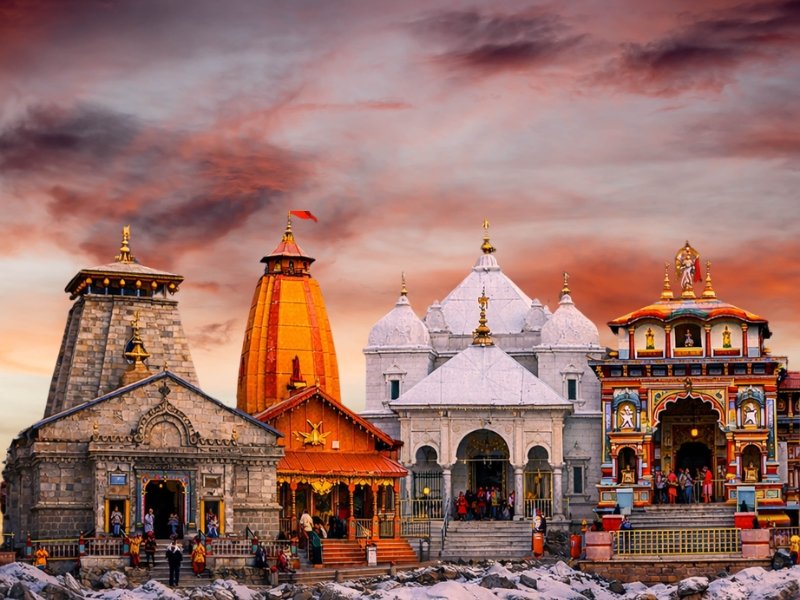
The Char Dham route leg by leg: Haridwar to Yamunotri, Gangotri, Kedarnath and Badrinath, with distances, drive times, treks, altitudes and the usual night stops.
By Teerthayan • October 2026
The Char Dham Yatra route (the 4 Dham Yatra) runs clockwise through the Garhwal Himalaya: Yamunotri first, then Gangotri, Kedarnath and Badrinath last. From Haridwar the round trip is roughly 1,300–1,400 km by road and takes about 10 days, plus two treks: about 6 km to Yamunotri and about 16–18 km to Kedarnath. This route map sets out every leg with its distance, drive time and usual night stop.
Char Dham Yatra route map at a glance
| Dham | Deity | Altitude | Last road point | Trek |
|---|---|---|---|---|
| Yamunotri | Goddess Yamuna | about 3,293 m | Janki Chatti | about 6 km |
| Gangotri | Goddess Ganga | about 3,100 m | Gangotri | none |
| Kedarnath | Lord Shiva (Jyotirlinga) | about 3,583 m | Sonprayag, then shuttle to Gaurikund | about 16–18 km |
| Badrinath | Lord Vishnu | about 3,133 m | Badrinath | none |
Leg-by-leg distances from Haridwar
Distances are approximate road distances; mountain driving times vary with traffic, roadworks and weather.
| Leg | Distance | Drive time | Usual night stop |
|---|---|---|---|
| Haridwar → Barkot (via Dehradun, Mussoorie) | about 210 km | 7–8 h | Barkot |
| Barkot → Janki Chatti → Yamunotri trek → Barkot | about 45 km each way + 6 km trek each way | full day | Barkot |
| Barkot → Uttarkashi | about 85–100 km | 4 h | Uttarkashi |
| Uttarkashi → Gangotri → Uttarkashi | about 100 km each way | 4 h each way | Uttarkashi |
| Uttarkashi → Guptkashi (via Tehri, Srinagar) | about 220 km | 8–9 h | Guptkashi / Sitapur |
| Guptkashi → Sonprayag → Gaurikund → Kedarnath | about 30 km + 16–18 km trek | full day | Kedarnath |
| Kedarnath → Gaurikund → Guptkashi | 16–18 km trek + about 30 km | full day | Guptkashi |
| Guptkashi → Badrinath (via Ukhimath, Chopta, Joshimath) | about 190–200 km | 7–8 h | Badrinath |
| Badrinath → Rishikesh / Haridwar (via the five prayags) | about 300–320 km | 10–12 h, often split | Rudraprayag or Rishikesh |
Starting from Delhi
Delhi to Haridwar is about 230 km, 5–6 hours by road. Add a day at each end: drive to Haridwar on the first day for the evening Ganga Aarti at Har Ki Pauri, and drive back from Rishikesh on the last day. That makes the Char Dham route about 12 days and roughly 1,500–1,600 km from Delhi. Trains run from Delhi to Haridwar, and the nearest airport is Jolly Grant, Dehradun.
Why the route runs clockwise
Tradition holds that the Char Dham Yatra moves from west to east, beginning with Goddess Yamuna and ending with Lord Badrinath. The roads follow the same logic: Yamunotri and Gangotri lie up neighbouring valleys in Uttarkashi district, the road then crosses to the Mandakini valley for Kedarnath, and finally to the Alaknanda valley for Badrinath, so no valley is driven twice.
Road conditions and season by leg
The four dhams open around Akshay Tritiya in late April or May and close between Diwali and mid-November, so the whole route is driven between those dates. Conditions change leg by leg:
- Haridwar to Barkot: good highway as far as Dehradun and Mussoorie, then a narrower hill road. Expect slow traffic through Mussoorie on weekends.
- Barkot to Janki Chatti: a single-lane road with steep drops; parking at Janki Chatti fills by mid-morning in May and June, so leave early.
- Uttarkashi to Gangotri: a scenic road up the Bhagirathi past Harsil; landslide-prone stretches near Gangnani slow traffic after rain.
- Uttarkashi to Guptkashi: the longest driving day, crossing from the Bhagirathi to the Alaknanda and Mandakini valleys via Tehri and Srinagar.
- Guptkashi to Sonprayag: short but slow in peak season, as vehicles queue for the registration check and the Gaurikund shuttle.
- Joshimath to Badrinath: the road climbs steeply beyond Vishnuprayag; in July and August this stretch is the one most often blocked by landslides.
May–June and September–October are the most reliable months. In the monsoon, keep at least one spare day in the plan and check road status each morning before leaving.
Points on the way worth stopping for
- Gangnani: hot spring on the road to Gangotri.
- Uttarkashi: the Kashi Vishwanath temple of the hills.
- Triyuginarayan: near Sonprayag, the wedding place of Shiva and Parvati.
- Ukhimath: Omkareshwar temple, Kedarnath's winter seat.
- Mana village: 3 km beyond Badrinath, with Vyas Gufa and Bhim Pul.
- Devprayag: where the Alaknanda and Bhagirathi meet to become the Ganga.
Planning the route
- Register every pilgrim with Uttarakhand Tourism before travelling; see our Char Dham registration guide.
- Start early every day: afternoons bring cloud, rain and slower traffic.
- Keep a buffer day in July and August, when landslides close roads.
- Kedarnath: a helicopter from Phata, Sersi or Guptkashi saves the trek; tickets are sold only on IRCTC's official HeliYatra website.
- Budget: see our Char Dham Yatra cost guide.
Char Dham packages on this route
The Char Dham Yatra from Haridwar follows this route in 10 days for ₹ 27,500 per person, and the Char Dham Yatra from Delhi in 12 days for ₹ 33,900 per person. With less time, the Do Dham Yatra covers Kedarnath and Badrinath only, in 6 days.
FAQs
What is the correct route order for the Char Dham Yatra?+
Clockwise from west to east: Yamunotri, Gangotri, Kedarnath and Badrinath. Haridwar or Rishikesh is the usual starting point.
How many kilometres is the Char Dham Yatra?+
Roughly 1,300–1,400 km by road from Haridwar and back, and about 1,500–1,600 km from Delhi, plus the treks to Yamunotri and Kedarnath.
How far is Kedarnath from Haridwar?+
About 230–250 km by road to Sonprayag (8–9 hours), then a shuttle to Gaurikund and a trek of about 16–18 km to the temple.
How many days does the Char Dham route take?+
About 10 days from Haridwar and 12 days from Delhi by road, including the treks and a night near Kedarnath.
Which dhams need a trek?+
Yamunotri (about 6 km from Janki Chatti) and Kedarnath (about 16–18 km from Gaurikund). Gangotri and Badrinath are reached by road.
Share this article