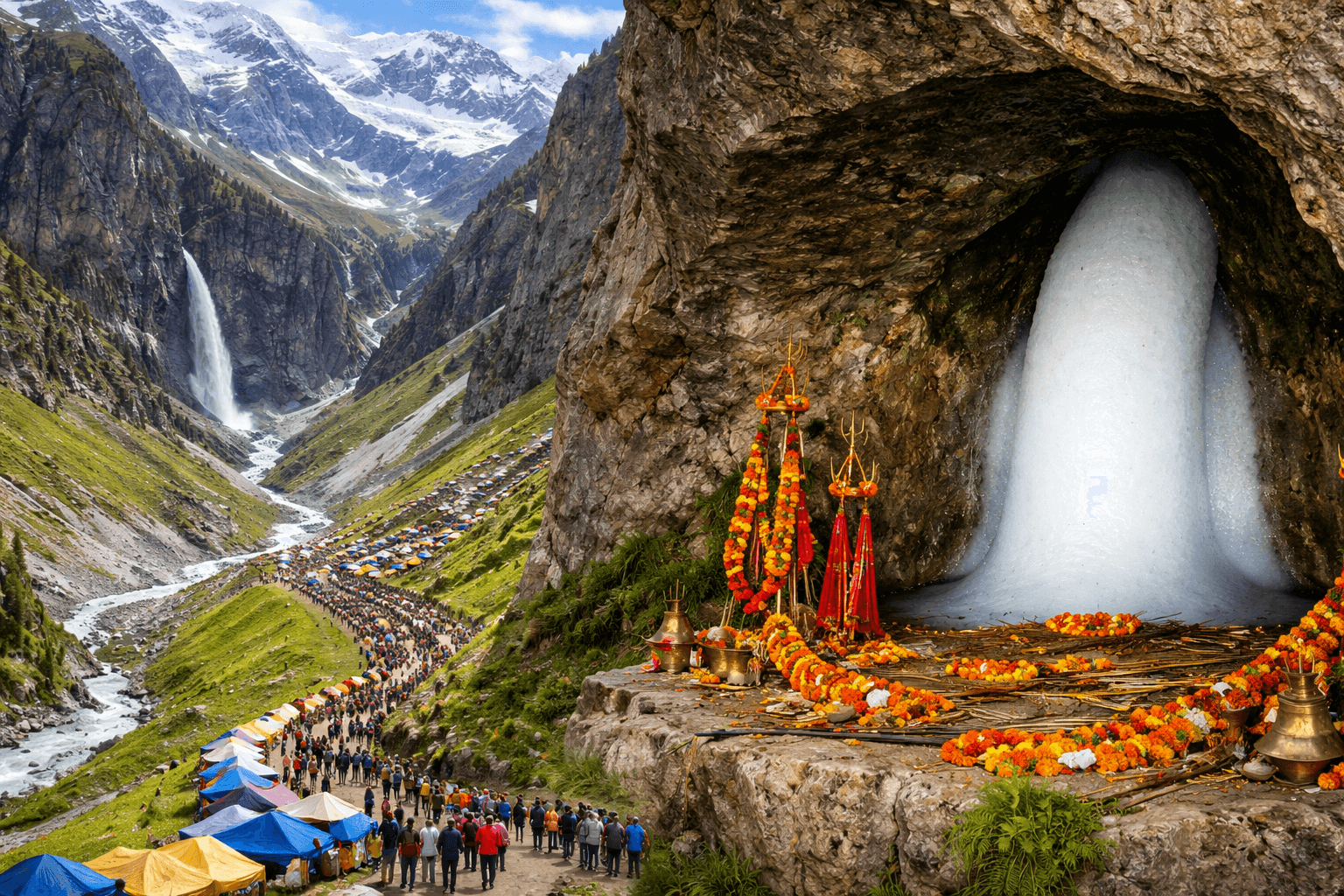
Everything to plan the Amarnath Yatra 2027: Shrine Board registration, the compulsory health certificate and RFID card, and how the Pahalgam and Baltal routes compare.
By Teerthayan • October 2026
For the Amarnath Yatra 2027 you will need three things before you leave home: an advance registration with the Shri Amarnathji Shrine Board (SASB), a Compulsory Health Certificate (CHC) signed by an authorised doctor, and an RFID yatra card collected in Jammu and Kashmir. You then choose between the longer, gentler Pahalgam route (about 32 km of trekking each way from Chandanwari) and the short, steep Baltal route (about 14 km each way). The 2027 dates and registration window are announced by the Shrine Board in spring, so treat the details below as a planning guide based on recent seasons.
Amarnath Yatra 2027 at a glance
| Season | About two months in July and August. The Shrine Board announces the 2027 dates in March or April; the yatra traditionally ends on Shravan Purnima, 17 August 2027. |
|---|---|
| Registration | Advance registration with the Shri Amarnathji Shrine Board, online or at partner bank branches (it opened on 15 April in 2026) |
| Documents | Compulsory Health Certificate from an authorised doctor, RFID yatra card collected in Jammu and Kashmir, photo ID |
| Age limit | 13 to 70 years (2026 rule) |
| Routes | Pahalgam: about 32 km each way from Chandanwari, 3 to 4 days up. Baltal: about 14 km each way, up and back in 1 to 2 days. |
| Cave altitude | About 3,880 m |
When will the Amarnath Yatra 2027 happen?
The yatra to the holy cave runs for roughly two months in the monsoon season. In 2026 it began on 3 July and was scheduled to close on 28 August, the day of Raksha Bandhan (Shravan Purnima). The yatra traditionally ends on Shravan Purnima, which falls on 17 August in 2027, but the official start and end dates for 2027 have not yet been announced. The Shrine Board usually confirms them in March or April, and advance registration opened on 15 April in 2026.
The best time within the season depends on what you want. The first two weeks see the largest ice lingam and the biggest crowds. Late July and August bring heavier rain, slippery paths and the risk of short suspensions, but somewhat thinner queues.
Registration: step by step
- Get your Compulsory Health Certificate. Only certificates issued on the prescribed form by doctors or medical institutions authorised by the Shrine Board are accepted, and the certificate must be dated after the cut-off date the Board notifies each year. Download the form and the list of authorised doctors from the official SASB website.
- Register online or at a bank branch. Advance registration is offered online on the SASB portal and offline at designated branches of partner banks across India. You choose a route and a date of yatra, and each permit is valid for that route and day.
- Collect your RFID yatra card. Every pilgrim must carry an RFID card, issued at verification centres in Jammu and Kashmir after biometric checks. Without a valid RFID card you will not be allowed past the access control gates at Domail (Baltal route) or Chandanwari (Pahalgam route).
- Keep copies. Carry the printed registration slip, the CHC and a photo ID at all times on the route.
Always use the official Shri Amarnathji Shrine Board website for forms, fees and the doctors' list. Fees and the exact rules are announced afresh each season.
Age limits and who should not go
In 2026 the Shrine Board allowed only pilgrims aged 13 to 70 to register. Expect the same limits in 2027 unless the Board says otherwise. The cave sits at roughly 3,880 metres, so anyone with heart, lung or blood pressure problems should take their doctor's advice seriously, not just collect a signature.
Pahalgam vs Baltal: which route suits you?
| Point | Pahalgam route | Baltal route |
|---|---|---|
| Base camp | Nunwan, near Pahalgam (about 90 km from Srinagar) | Baltal, near Sonamarg (about 95 km from Srinagar) |
| Trek to the cave (one way) | About 32 km from Chandanwari, which is about 12 km by road from Nunwan | About 14 km from Baltal via Domail and Brarimarg |
| Usual stops | Chandanwari, Pissu Top, Sheshnag, Mahagunas Pass, Panchtarni | Domail, Brarimarg, Sangam |
| Typical time | 3 to 4 days up, 1 to 2 days back | Up and back in 1 to 2 days |
| Gradient | Longer but more gradual; one high pass | Short but steep, especially near Sangam |
| Best for | Fit pilgrims who want the traditional route and scenery | Pilgrims short on time who can handle steep climbs |
Both routes meet near the cave. Ponies, palkis and porters are available on both, at rates notified by the authorities. Many pilgrims climb by Pahalgam and return by Baltal, but your permit is tied to a route, so check what the current rules allow before planning a mixed route.
Helicopter option
In seasons when it runs, helicopter service is booked only through the Shrine Board's official channel. It has flown from Neelgrath (Baltal side) and from Pahalgam to Panchtarni, leaving a walk or pony ride of about 6 km to the cave. Whether helicopters operate in 2027, and the fares, will be announced closer to the season. Book only on the official portal; fake helicopter booking websites are a known problem.
Planning with Teerthayan
If you would rather not organise the Srinagar stays and road transfers yourself, see our Amarnath Yatra package from Srinagar. For a longer trip that adds the high-altitude landscapes of Ladakh, see the Amarnath Yatra with Ladakh tour. In both cases each pilgrim still needs their own valid registration, CHC and RFID card, as required by the Shrine Board.
How to prepare your body
- Start walking 4 to 5 km a day at least a month before departure, adding stairs or hill walks in the last two weeks.
- Practise slow, deep breathing; high altitude rewards a steady pace, not speed.
- Spend a night in Srinagar, Pahalgam or Sonamarg before the trek to adjust to the altitude.
- Drink plenty of water and avoid alcohol and smoking during the yatra.
- Turn back if you feel severe headache, breathlessness at rest or confusion. These are warning signs of altitude sickness.
What to carry
- Registration slip, CHC, RFID card and a government photo ID, in a waterproof pouch.
- Woollens, a warm jacket, a raincoat or poncho, gloves and a cap. Nights at Sheshnag and Panchtarni are cold even in July.
- Trekking shoes with good grip; avoid new shoes. A walking stick helps on the descent.
- Personal medicines, a small first-aid kit, sunscreen and sunglasses.
- Dry snacks, a refillable water bottle and a torch.
Our guide on what to carry on a pilgrimage has a fuller checklist you can print.
Common mistakes to avoid
- Getting a health certificate from a doctor who is not on the authorised list. It will be rejected.
- Booking flights before your yatra date and route are confirmed.
- Trying to do the Baltal route in a single day without being fit for it.
- Booking ponies or helicopters through agents who are not authorised.
Plan early, confirm later
The Amarnath Yatra 2027 will follow the pattern of recent years, but dates, fees and some rules change every season. Get fit now, keep an eye on the Shrine Board's announcements in early 2027, and book your travel only once your registration is confirmed. If you are also thinking of other Himalayan yatras next year, our Kedarnath Yatra guide covers a route with a similar level of effort.
FAQs
When will the Amarnath Yatra 2027 start?+
The Shri Amarnathji Shrine Board has not yet announced the 2027 dates. The yatra usually runs from early July and traditionally ends on Shravan Purnima, which is 17 August in 2027. The Board normally confirms dates in spring.
Is a health certificate compulsory for Amarnath Yatra?+
Yes. Every pilgrim needs a Compulsory Health Certificate on the prescribed form from a doctor or institution authorised by the Shrine Board, issued after the cut-off date the Board notifies.
What is the age limit for Amarnath Yatra?+
In 2026 only pilgrims aged 13 to 70 could register. Check the Shrine Board's 2027 notice for any change.
Which is easier, Pahalgam or Baltal?+
Pahalgam is longer, about 32 km from Chandanwari, but more gradual and usually takes 3 to 4 days up. Baltal is about 14 km but much steeper and can be done in 1 to 2 days.
Is the RFID card necessary?+
Yes. Without a valid RFID yatra card you are not allowed past the access control gates at Domail on the Baltal route or Chandanwari on the Pahalgam route.
Share this article