Ayodhya, Prayagraj and Varanasi lie on one road corridor and fit into four to six days. Here is the route map, distances, sights and a day-by-day plan.
By Teerthayan • October 2026
Ayodhya, Prayagraj and Varanasi sit on one road corridor in eastern Uttar Pradesh, and the easiest way to cover them is in a line: Ayodhya first, Prayagraj in the middle, Varanasi last. Ayodhya to Prayagraj is roughly 170 km by road, Prayagraj to Varanasi is about 125 km, and the full loop fits comfortably into four to six days. This guide sets out the route as a simple map table, what to see in each city, a day-by-day plan and the practical details for an Ayodhya Varanasi Prayagraj tour in 2026-27.
Route map: how Ayodhya, Prayagraj and Varanasi connect
Think of the three cities as points on a triangle. Ayodhya lies to the north on the Saryu, Prayagraj to the south-west at the meeting of the Ganga and Yamuna, and Varanasi to the south-east on the Ganga. Most pilgrims travel Ayodhya → Prayagraj → Varanasi (or the reverse), because it avoids doubling back and ends at a city with a large airport and railway junction.
| Leg | Approx. road distance | Approx. drive time | Notes |
|---|---|---|---|
| Lucknow → Ayodhya | about 140 km | 3 hours | Useful if your flight lands at Lucknow |
| Ayodhya → Prayagraj | about 170 km | 4–5 hours | Main leg of the circuit |
| Prayagraj → Varanasi | about 125 km | 3–4 hours | Highway drive across the Ganga plains |
| Ayodhya → Varanasi (direct) | about 200–220 km | 4–5 hours | If you skip Prayagraj or visit it as a day trip |
| Varanasi → Sarnath | about 10 km | 30 minutes | Half-day excursion |
Drive times depend on traffic, festival crowds and fog in December and January, so keep buffer time on travel days.
Ayodhya: the city of Shri Ram
Ram Janmabhoomi Mandir
The new Ram Mandir at the Ram Janmabhoomi is the reason most pilgrims come. Expect security checks and long queues on weekends and festival days. Mobile phones and most electronic items are not permitted inside the temple premises, and lockers are provided outside; check the current rules on the trust's official website before you go, as timings and procedures are revised from time to time.
Hanuman Garhi and Kanak Bhawan
Tradition holds that devotees visit Hanuman Garhi before Ram Lalla. The shrine sits on a raised mound reached by a flight of steps, so allow time if you have elderly family members. Kanak Bhawan, associated with Sita and Rama, is close by and quieter.
Saryu aarti at Ram Ki Paidi
Evenings belong to the Saryu. Lamps, bells and chanting along Ram Ki Paidi make the aarti the most peaceful part of an Ayodhya visit. Guptar Ghat, Dashrath Mahal, Sita Ki Rasoi and Nageshwarnath Temple can be added if you have a full day.
Prayagraj: the Triveni Sangam
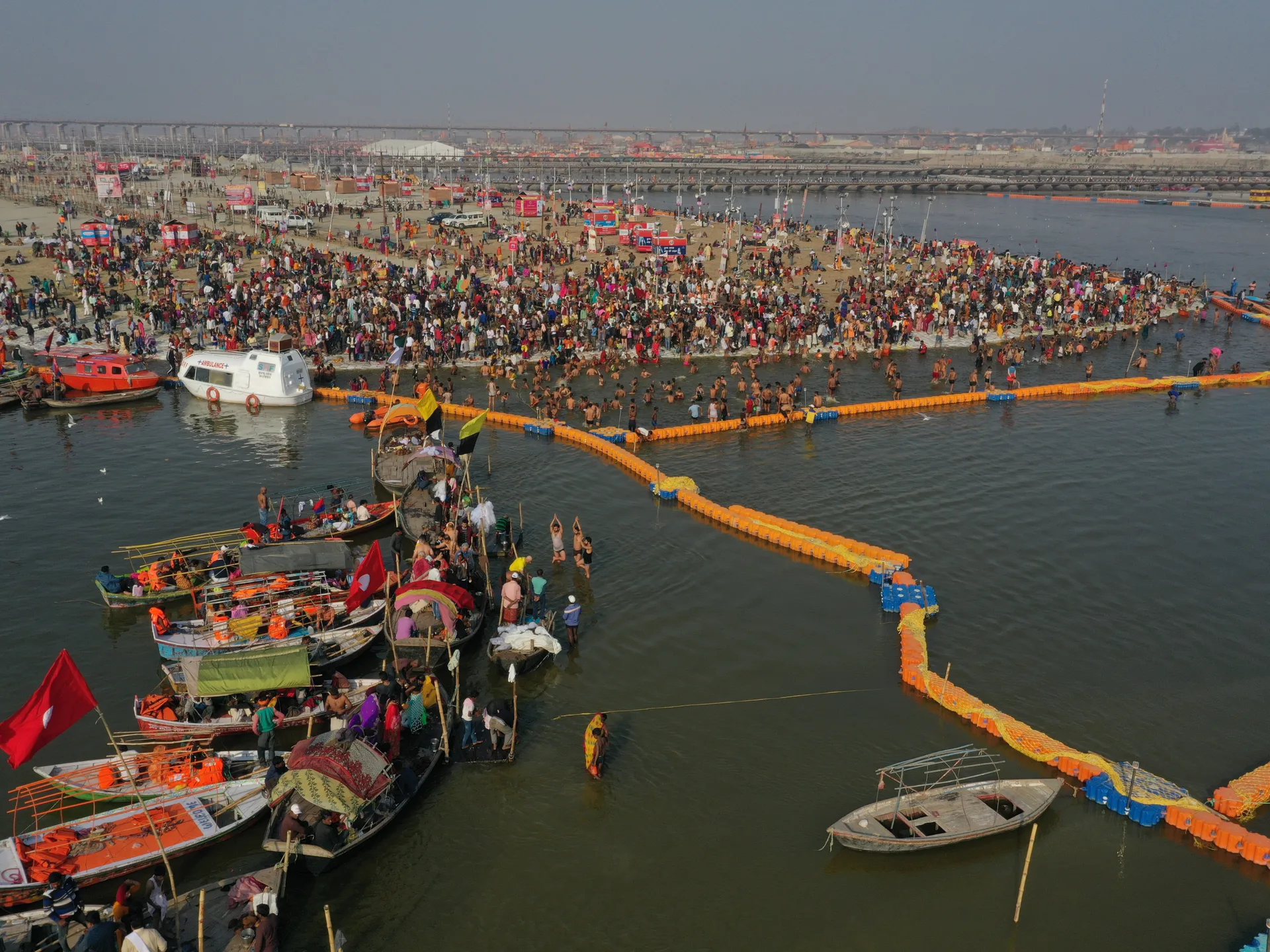
Prayagraj is called Tirtharaj, the king of pilgrimage places. Boats leave from the ghats near the fort for the Sangam, where the muddy Ganga and the greener Yamuna meet, with the Saraswati believed to join unseen. Take a holy dip from the boat platforms, then visit the Lete Hue Hanuman Temple, the Akshayavat and Bharadwaj Ashram. If you are planning around the Ardh Kumbh, read our guide on how to reach Kumbh Mela 2027 for crowd planning ideas.
Varanasi (Kashi): Vishwanath, Ganga Aarti and the ghats
Kashi Vishwanath Jyotirlinga
Kashi Vishwanath is one of the twelve Jyotirlingas, and the Shri Kashi Vishwanath Dham corridor now links the temple directly to the river. Phones, bags and leather items are usually deposited before entry. Darshan arrangements and aarti tickets are listed on the temple trust's official site. If you are planning more Jyotirlinga visits, see our 12 Jyotirlinga list and yatra guide.
Ganga Aarti at Dashashwamedh Ghat
The evening Ganga Aarti is held daily at Dashashwamedh Ghat. Reach early for a spot on the steps, or watch from a boat on the river.
Sunrise boat ride and the ghats
A dawn boat ride from Assi to Manikarnika shows Kashi at its most authentic. Kaal Bhairav, Annapurna Devi, Sankat Mochan and Tulsi Manas Mandir are worth adding, and Sarnath makes a calm half-day trip.
Suggested 4, 5 and 6 day plans
| Day | 4 days (fast) | 6 days (relaxed) |
|---|---|---|
| 1 | Ayodhya: Ram Mandir, Hanuman Garhi, Saryu aarti | Arrive Ayodhya, Saryu aarti |
| 2 | Drive to Prayagraj, Sangam boat and dip | Ayodhya full day: Ram Janmabhoomi, Hanuman Garhi, Kanak Bhawan, Guptar Ghat |
| 3 | Drive to Varanasi, Ganga Aarti | Drive to Prayagraj, Triveni Sangam, Lete Hue Hanuman |
| 4 | Sunrise boat, Kashi Vishwanath, depart | Drive to Varanasi, evening Ganga Aarti |
| 5 | – | Sunrise boat, Kashi Vishwanath, Kaal Bhairav, Sarnath |
| 6 | – | Optional darshan, depart from Varanasi |
A five-day version simply drops the second full day in Ayodhya or the Sarnath excursion. Four days works, but it leaves almost no slack for darshan queues.
Best time for an Ayodhya Varanasi Prayagraj tour
October to March is the most comfortable window. Days are pleasant, and festivals such as Dev Deepawali in Kashi and Deepotsav in Ayodhya fall in this season, though crowds and hotel rates rise around them. December and January bring dense morning fog that can delay trains, flights and early boat rides. April to June is very hot, and the monsoon (July to September) raises river levels, which can restrict boating at the Sangam and the ghats.
How to reach
- By air: Ayodhya has Maharishi Valmiki International Airport; Varanasi has Lal Bahadur Shastri International Airport; Prayagraj also has a domestic airport. Lucknow is a further option for Ayodhya. A common plan is to fly into Ayodhya or Lucknow and fly out of Varanasi.
- By train: Ayodhya Dham, Prayagraj Junction and Varanasi Junction are well connected with Delhi, Mumbai, Kolkata and other major cities.
- By road: A private car between the three cities is the most flexible option, especially with elderly travellers.
Pack light and modestly for temple visits; our pilgrimage packing checklist covers the essentials.
Teerthayan packages for this circuit
The Ram Kashi Yatra follows exactly this route over 5 Nights / 6 Days, priced from ₹ 19,500. It includes hotel stays in Ayodhya, Prayagraj and Varanasi, breakfast and dinner, a private AC vehicle for the Ayodhya–Prayagraj–Varanasi road journey, a boat ride at the Triveni Sangam, a sunrise boat ride on the Ganga, the evening Ganga Aarti at Dashashwamedh Ghat and a Sarnath excursion. Travelling from Delhi and keen to add Mahakaleshwar? The Kashi Mahakaal Yatra (6 Days / 5 Nights, from ₹ 18,500) combines Varanasi and Prayagraj with Ujjain.
Whichever way you plan it, an Ayodhya Varanasi Prayagraj tour joins Ram, the Sangam and Shiva in one short journey. For other circuits, browse our overview of temple tours of India.
FAQs
What is the distance from Ayodhya to Varanasi?+
By road Ayodhya to Varanasi is roughly 200–220 km, about 4–5 hours. Going via Prayagraj adds distance: about 170 km to Prayagraj and then about 125 km on to Varanasi.
How many days are enough for Ayodhya, Prayagraj and Varanasi?+
Four days covers the main darshans at a fast pace. Five or six days allows a full day in Ayodhya, an unhurried Sangam visit, a sunrise boat ride in Kashi and a Sarnath excursion.
Which order is best for visiting the three cities?+
Ayodhya → Prayagraj → Varanasi works well because it follows the road in one line and ends at Varanasi, which has good flight and train connections for the return.
Are mobile phones allowed in Ram Mandir and Kashi Vishwanath?+
Phones and most electronic items are generally not permitted inside either temple, and lockers are available outside. Rules can change, so check the temple trusts' official websites before your visit.
What is the best time to visit Ayodhya, Prayagraj and Varanasi?+
October to March is the most comfortable period. Expect fog-related delays in December and January, heat from April to June, and high river levels during the monsoon.
Share this article