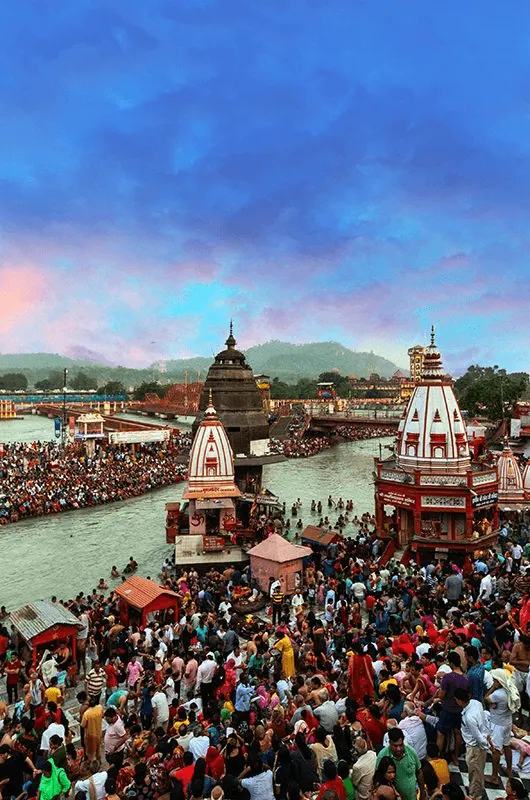
Ardh Kumbh every 6 years, Purna Kumbh every 12, Maha Kumbh once in 144. Here is what each means, how the cycle works, and why Haridwar 2027 is an Ardh Kumbh.
By Teerthayan • October 2026
The simplest way to understand the difference between Ardh Kumbh, Purna Kumbh and Maha Kumbh is to look at how often each one happens and where it is held. An Ardh Kumbh (the half Kumbh) comes every six years, and only at Haridwar and Prayagraj. A Purna Kumbh (the full Kumbh) comes every twelve years, and rotates between four holy cities. A Maha Kumbh (the great Kumbh) is the rarest of all, said to come once in 144 years, and only at Prayagraj. By this reckoning, the Kumbh that Haridwar will host in 2027 is an Ardh Kumbh, six years after the full Kumbh of 2021.
The four Kumbh cities and why the mela moves
The Kumbh Mela is not fixed to one place. It rotates between four river cities tied to the legend of the churning of the ocean, when drops of amrit (the nectar of immortality) are believed to have fallen: Prayagraj on the Ganga-Yamuna-Saraswati sangam, Haridwar on the Ganga, Nashik (Trimbak) on the Godavari, and Ujjain on the Shipra. Each city takes its turn by the position of the planets, so a Kumbh of one kind or another takes place somewhere in India every few years.
Because the four cities are on staggered schedules, the names can confuse first-time pilgrims. The type of Kumbh depends on the city and the year, not on the size of the crowd. Here is how the three terms compare.
Difference between Ardh Kumbh, Purna Kumbh and Maha Kumbh
| Type | How often | Where it is held | Recent or next |
|---|---|---|---|
| Ardh Kumbh | Every 6 years | Haridwar and Prayagraj only | Haridwar 2016 and 2027 |
| Purna Kumbh | Every 12 years, per city | Haridwar, Prayagraj, Nashik, Ujjain | Haridwar 2010, 2021; next 2033 |
| Maha Kumbh | Once in 144 years | Prayagraj only | Prayagraj 2025 |
Ardh Kumbh, the half Kumbh
Ardh means half. An Ardh Kumbh falls midway between two full Kumbhs at the same city, roughly six years after the last Purna Kumbh. Only Haridwar and Prayagraj observe an Ardh Kumbh. It is smaller on paper than a Purna Kumbh, but the bathing days, the Akharas and the Amrit Snan processions are all there, and the crowds still run into millions.
Purna Kumbh, the full Kumbh
Purna means complete. A Purna Kumbh comes to each of the four cities once every twelve years, when the planets return to the same position for that city. Haridwar's last full Kumbh was in 2021; before that, 2010. At Nashik and Ujjain the twelve-year Kumbh is also called the Simhastha, because it is held when Jupiter is in Leo (Simha). Nashik's Simhastha Kumbh falls in 2027, with Ujjain's turn in 2028.
Maha Kumbh, the 144-year Kumbh
Maha means great. The Maha Kumbh is the rarest of all, held only at Prayagraj and said to come once in 144 years, that is, after twelve full Kumbhs of twelve years each. Prayagraj hosted a Maha Kumbh in 2025, which is why you may have read the word everywhere last year. A Maha Kumbh is never held at Haridwar; Haridwar's grandest gathering is its Purna Kumbh.
How the twelve-year cycle is calculated
The timing of every Kumbh is set by Hindu astrology, not by a fixed calendar date. The twelve-year rhythm comes from Jupiter (Brihaspati), which takes about twelve years to travel once around the zodiac. The exact city and dates depend on where Jupiter, the Sun and the Moon sit at the time. At Haridwar the Kumbh is held when Jupiter is in Aquarius (Kumbh rashi) and the Sun enters Aries (Mesha), which is also why the main bathing days cluster around Makar Sankranti in January and Mesh Sankranti (Baisakhi) in April.
Why Haridwar 2027 is an Ardh Kumbh
Haridwar held its last Purna Kumbh in 2021. An Ardh Kumbh comes six years after a full Kumbh, so Haridwar's next gathering, in 2027, is an Ardh Kumbh. The one before it was the Ardh Kumbh of 2016. The next Purna Kumbh at Haridwar will not come until 2033. So while 2027 is only a half Kumbh by the calendar, it is the main Ganga mela Haridwar will see for years, and the Uttarakhand government has said it will be organised on the scale of a Purna Kumbh.
Ardh Kumbh 2027 dates and bathing days
The Haridwar Ardh Kumbh 2027 is set to run from 14 January 2027 (Makar Sankranti) to 20 April 2027 (Chaitra Purnima). The state government has announced ten major bathing days across these months, of which three are Amrit Snan (royal bath) days: 6 March (Mahashivratri), 8 March (Phalguna Amavasya) and 14 April (Mesh Sankranti, Baisakhi). The final mela calendar and crowd rules are usually confirmed closer to the season, so check the latest notice before you fix your dates.
| Period | Key day | What it marks |
|---|---|---|
| Mid-January | 14 January 2027 | Makar Sankranti, the Kumbh opens |
| Early March | 6 and 8 March 2027 | Mahashivratri and Phalguna Amavasya Amrit Snans |
| Mid-April | 14 April 2027 | Mesh Sankranti (Baisakhi) Amrit Snan |
| Late April | 20 April 2027 | Chaitra Purnima, the Kumbh closes |
Planning a Haridwar Ardh Kumbh 2027 trip
If you are planning to be in Haridwar for the Ardh Kumbh, two things decide your trip: which bathing day you want to be there for, and where you will stay. The Amrit Snan days draw the largest crowds, so first-time pilgrims and families often pick a quieter bathing day, or the days just before or after. For tents, camps and hotels during the mela, see our Haridwar Kumbh Mela page, and read the Haridwar Kumbh Mela 2027 trip plan for how to reach and a simple three-day itinerary. To understand the royal-bath processions, see our guide to the Amrit Snan (Shahi Snan).
Nashik also hosts its twelve-year Simhastha Kumbh in 2027 on the Godavari, so 2027 is a rare year with two Kumbhs; if you are weighing the two, our note on how to reach the Nashik Kumbh may help. Whichever you choose, the difference between Ardh Kumbh, Purna Kumbh and Maha Kumbh comes down to the same thing: the planets, the place and the twelve-year turn of Jupiter.
FAQs
Is Haridwar Kumbh 2027 an Ardh Kumbh or a Purna Kumbh?+
It is an Ardh Kumbh, six years after Haridwar's 2021 Purna Kumbh. The next Purna Kumbh at Haridwar is due in 2033. The Uttarakhand government has said the 2027 Ardh Kumbh will be organised on the scale of a full Kumbh.
What is the difference between Ardh Kumbh and Purna Kumbh?+
An Ardh Kumbh comes every six years and only at Haridwar and Prayagraj. A Purna Kumbh comes every twelve years and rotates between Haridwar, Prayagraj, Nashik and Ujjain.
How often does the Maha Kumbh happen?+
The Maha Kumbh is held only at Prayagraj, once in 144 years, after twelve full Kumbhs. Prayagraj hosted a Maha Kumbh in 2025.
Why does the Kumbh Mela move between four cities?+
Each city's Kumbh is set by the planets, mainly the position of Jupiter. As Jupiter moves through the zodiac over about twelve years, the Kumbh comes to Prayagraj, Haridwar, Nashik and Ujjain in turn.
When is the next Purna Kumbh at Haridwar?+
Haridwar's next full Purna Kumbh is due in 2033, twelve years after 2021. The 2027 event is the Ardh Kumbh that falls midway between.
Share this article